On this page
- What is happening with AI brand tracking
- What AI Brand Tracking Actually Measures
- The Difference Between AI Brand Tracking and Traditional Brand Monitoring
- Why 2026 Is the Year This Becomes Non-Negotiable
- Can you just do SEO with a few tweaks?
- How this platform fixes AI Brand Tracking
- What to Track and When
If someone asks ChatGPT to recommend a CRM for a small sales team, and your brand doesn't appear in that answer, you've lost a prospect before they ever reach your website. That's a revenue problem and as markters we get blamed quite often for revenue, don't we? But now that we know that buyers are making decisions inside AI tools, we can fix this problem.
AI brand tracking is the practice of monitoring how, when, and where your brand appears inside AI-generated responses. Specifically: when users ask ChatGPT, Perplexity, Gemini, Claude, or any other AI-powered search tool a question in your category, what does the AI say about you?
This is the new way of brand discovery and since we are still in the early stages you still have time to gain an edge.
What is happening with AI brand tracking
The scale of AI search adoption is impossible to ignore. ChatGPT alone now processes more than 1 billion queries per day and has reached over 800 million weekly active users, according to OpenAI data reported by DemandSage. Perplexity processed 780 million queries in a single month in 2025, tripling its volume from the year before. Google's AI Overviews now appear in more than 25% of all searches and reach 2 billion monthly users across 200 countries (TechCrunch, SE Ranking).
Meanwhile, Gartner predicted in 2024 that traditional search engine volume would drop 25% by 2026 as users shift to AI assistants. The data from 2025 suggests that trajectory is well on course.
The users who've already moved aren't typing keywords into Google and scanning links. They're asking questions and getting answers. And the brands that appear in those answers didn't get there by accident.
What AI Brand Tracking Actually Measures
AI brand tracking is not the same as traditional brand monitoring. You're not scanning social feeds or tracking press hits. You're measuring how AI models represent your brand inside the responses they generate. Specifically:
- Mention rate: how often your brand appears when users ask AI questions in your category
- Sentiment and framing: whether the AI describes your brand positively, neutrally, or negatively, and what language it uses
- Share of voice: how you compare to competitors appearing in the same AI responses
- Citation sources: which websites, articles, and platforms the AI draws from when talking about you
- Response accuracy: whether the information the AI has about your brand is actually correct
- Platform breakdown: how your visibility differs across ChatGPT, Perplexity, Gemini, and Claude
Each of these metrics tells you something different. Mention rate tells you whether you're in the conversation at all. Sentiment tells you how the AI is positioning you. Citation sources tell you where your AI authority is actually coming from. Together, they give you a complete picture of your brand's AI search presence.
The Difference Between AI Brand Tracking and Traditional Brand Monitoring
Traditional monitoring tools like Brandwatch, Mention, Sprinklr are built to catch publicly indexed content. They crawl social media, news sites, forums, and review platforms. They're excellent at what they do.
But AI-generated responses are not publicly indexed. When ChatGPT generates an answer about your brand in a private conversation, that content doesn't appear anywhere on the web. No crawler can catch it. No alert can surface it.
The only way to know what AI models say about your brand is to ask them systematically, repeatedly, with a consistent set of prompts that represent real user intent in your category. That's what AI brand tracking does.
Why 2026 Is the Year This Becomes Non-Negotiable
The data is clear on the direction of travel. According to Bain and Company (2025), around 80% of users now rely on AI summaries for at least 40% of their searches. Among users under 30, approximately 31% say they begin searches using AI platforms or chatbots rather than Google, according to Pew Research and Marketing Dive.
These are the users forming opinions about your brand, comparing it to competitors, and making purchase decisions often without ever visiting your website. AI search converts at 14.2% compared to Google's 2.8%, according to data from upGrowth, which tells you that the users coming through this channel are not casual browsers. They're intent-driven.
And here's the thing about intent-driven discovery: the brand that shows up in the AI's answer has an enormous advantage over the one that doesn't. There are no page two results. There's no scrolling. The AI gives an answer. The user acts on it.
Can you just do SEO with a few tweaks?
Traditional SEO tools track none of this. Google Search Console tells you nothing about whether ChatGPT mentioned you this week. Semrush shows you your keyword rankings, not your AI sentiment score. Even the most sophisticated marketing stack typically has a complete blind spot when it comes to generative AI visibility.
Research from Ahrefs in 2025 found that approximately 80% of URLs cited in AI search results across ChatGPT, Perplexity, and other platforms do not rank in Google's top 100 results for the same query. This is the part that should stop every SEO in their tracks: the AI is not simply citing the top-ranked pages. It's drawing from a completely different set of sources, many of which have no traditional SEO presence at all.
If you're optimising entirely for Google rankings and not tracking your AI presence, you're measuring the wrong channel.
How this platform fixes AI Brand Tracking
Upsearch is built specifically for this problem. It tracks your brand's mention rate, sentiment, and citation sources across ChatGPT, Perplexity, Gemini, and Claude, and aggregates that data into a single Visibility Score, a trackable metric that moves as your AI search presence improves or declines.
Instead of running manual prompts and logging results in a spreadsheet, you get automated tracking, competitive benchmarks, trend data over time, and citation intelligence that tells you exactly which sources are driving (or hurting) your AI visibility. Monthly GEO strategy reports translate that data into specific actions.
Run a free search on Upsearch when you sign up and you'll see immediately where your brand stands across the major AI platforms. That's your baseline. Everything you do from there is optimisation.
What to Track and When
If you're building an AI brand tracking practice from scratch, here's the prioritised list of metrics:
- Mention rate across each AI model (the foundation)
- Sentiment trend over time (are you being framed more or less positively?)
- Share of voice vs top three competitors (how do you compare?)
- Citation source list (where is the AI getting its information about you?)
- Response accuracy (is what the AI says about you actually true?)
Monthly tracking is the right cadence for most brands. If you're running an active GEO campaign, building citation sources, updating entity data, implementing structured data, weekly tracking lets you see what's moving and what isn't.
If you get obsessed with data, you can also track your prompts weekly and daily and try to see if you spot any patterns.
The most important thing is to start. Most brands are operating with zero AI visibility data right now. Every month you wait is a month your competitors might be building an advantage you can't see.
Further reading: How to Measure Your Brand's Visibility Across AI Search Engines | What Is Generative Engine Optimisation (GEO) and How Do You Do It?
Newsletter
Get the next AI search signal in your inbox.
Short, useful updates on AI visibility, citations, prompts, and category positioning.
No spam, unsubscribe anytime. See our privacy policy.
Related reading
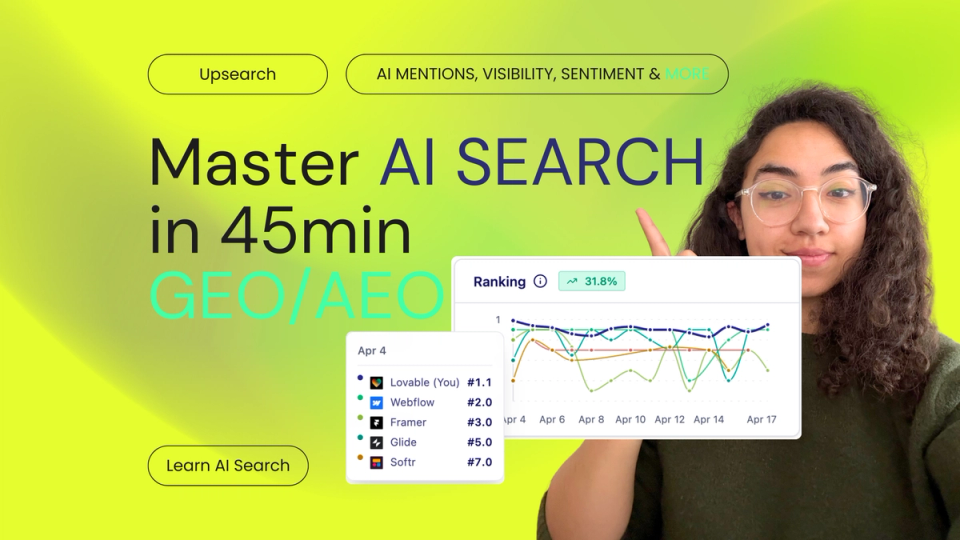
Masterclass in AI search
A video-based guide to advanced AI search optimization concepts.
The New SEO You Can't Afford to Ignore
The era of the blue link is giving way to the age of AI synthesis. Discover the architectural foundations of generative engine optimization and learn how to optimize your business for ChatGPT, Claude, and Gemini with Upsearch.
The Metric That Will Define Marketing in 2026
In 2026, blue search links are taking a backseat to generative engine answers. Here is how advanced AI brand visibility tracking helps your business dominate the conversational web without relying on short-lived hacks.
From insight to execution
Track how AI engines actually describe your brand.
Upsearch helps teams monitor prompt visibility, competitive positioning, and citations across the answer engines that now shape real buying journeys.